







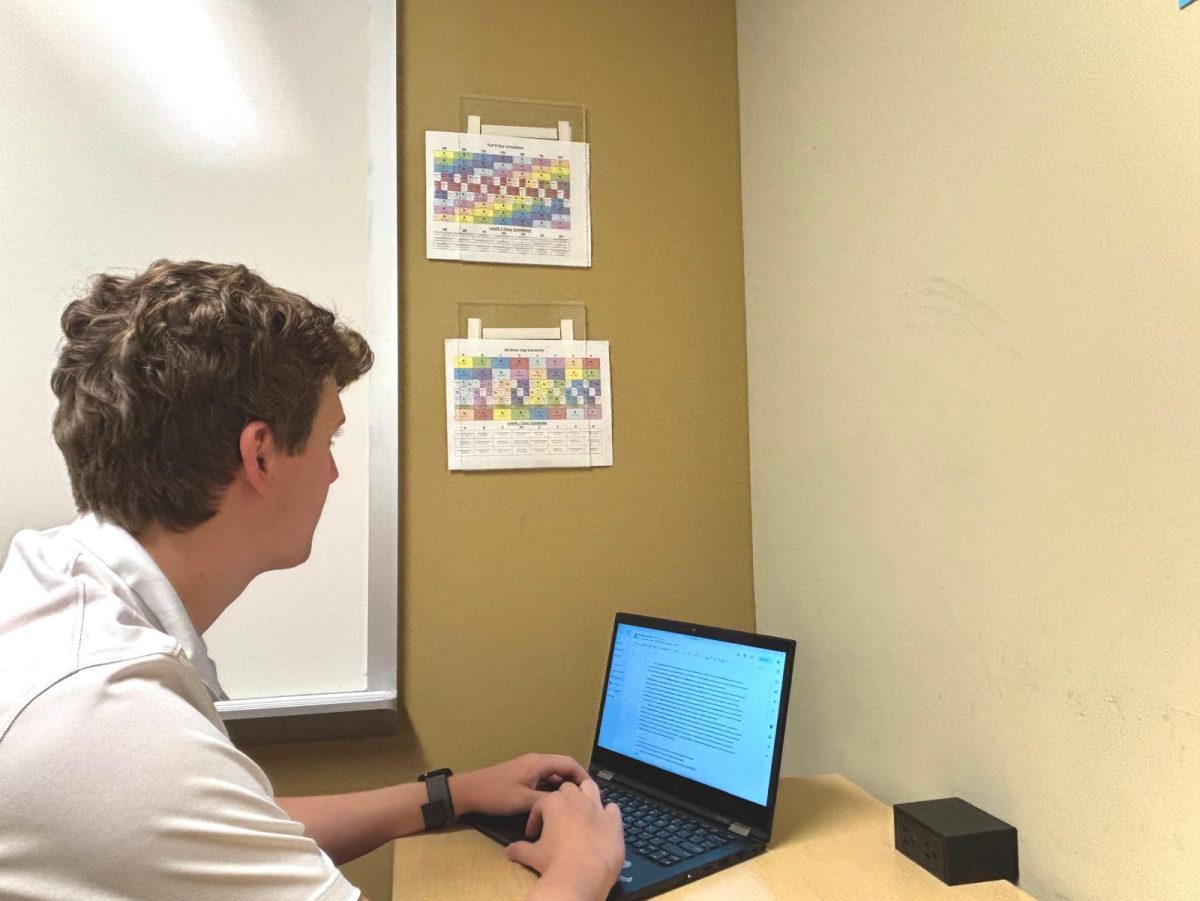




As MICDS approaches five years since the implementation of the current daily schedule, debate over the quality of the schedule has continued. For example, the rotation is non-standard, at times. Last week, Monday was G Day, and Tuesday was H, and so all MICDS students knew that A9 followed on Wednesday. But when the week starts with F and G, A9 still follows on Wednesday.
“When we have new students or new faculty or new staff join, there is definitely a learning curve with a schedule,” said Dr. Julia Hansen, English teacher. “Too much thinking energy is going into trying to figure what the schedule is rather than being able to follow the schedule.”
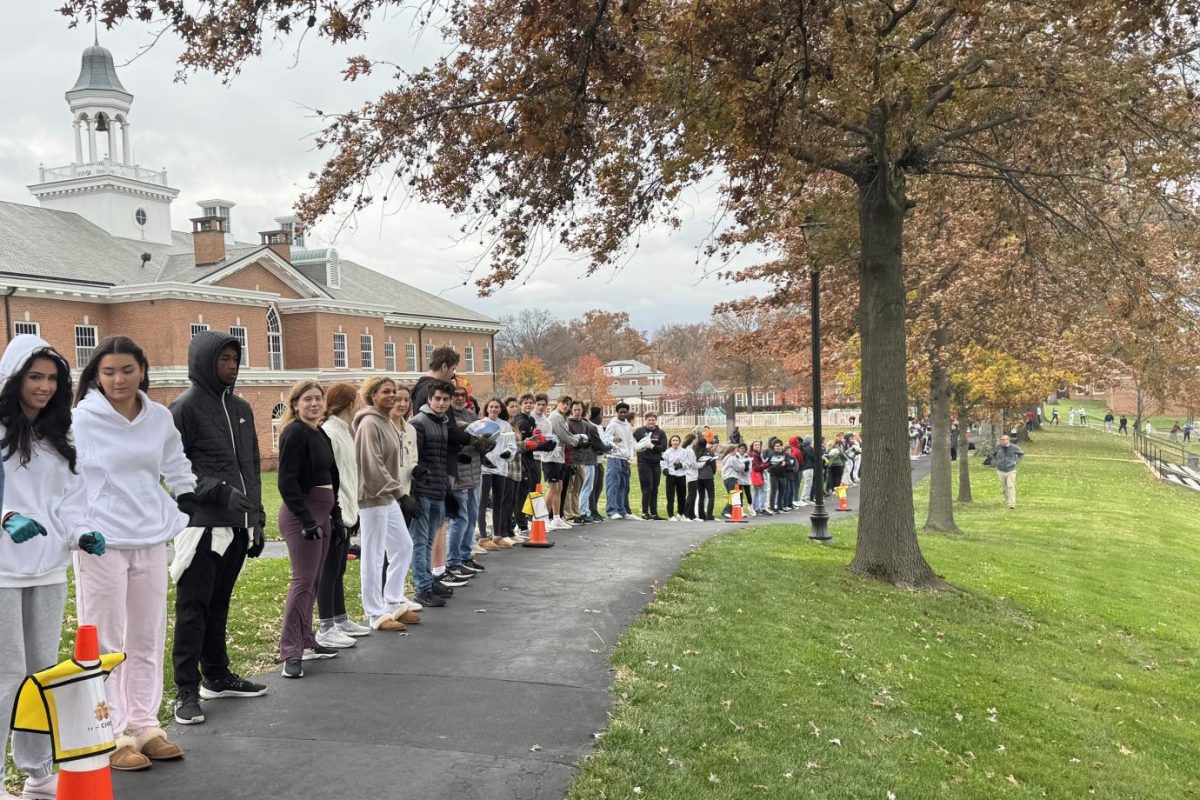
F Block was adjusted and H Block was skipped last Thursday, April 23, due to the plan for Field Day. Although the H Block exists to provide flexibility for various commitments at a time when no classes are scheduled, whether each one will contain advisory, assembly, club activities, or double collab is at the discretion of the administration.
“I feel like if advisory was once or twice a week, like an actual structure where you know when you’re having it, sort of like assemblies are Tuesday and Friday, [would be better] because advisory is a good relaxation time,” David Levison ’26 said. “Activities is really inconsistent when it happens, and I feel like not a lot of people use that time [for clubs] and just do quiet study instead.”
“The school doesn’t support extracurricular activities enough,” Forest Gong ’27 said. “Obviously, we have a sports requirement, but I know that at Ladue [Horton Watkins High School] science olympiad, debate, and whatever, meet every single day like a sport, but we don’t have an opportunity to do that.” This academic year, MICDS will average 13.8 school days between activity periods.
This week, due to the Senior Walkthrough on Thursday afternoon, MICDS will operate a D, E, G, F day rotation, causing unconventionally inconsistent intervals between the same block. For instance, there will be fewer than 20 hours between the two 90-minute C blocks, while there will be more than 70 hours between the two F blocks of the same length.
The absence of a 9 day (with 45 minutes classes) this week comes as a relief to some, who reckon that the time is not used effectively.
“With the walking [between buildings] and everything, a 45 minute class ends up being close to 30 or 35 minutes. At that point, you feel like there’s not much that you can do with just the attention in the classroom setting on 45 minute block days,” Ramya Mariappan ’26 said.
“I hate the 9 days,” Dana Self, choir director, said. “I think that we could use them better if we just stayed on the 90 minute cycle every day, or put the 9 days at the beginning of the week or something. I just don’t like the Wednesdays. It’s hard on me; it’s hard on the kids, and I’m not really aware of all the homework that people apparently pile on.”
Hansen holds a different perspective. “If one of the advantages of the 90 minutes is the opportunity to for movement of thought and really having time and space to invite different perspectives, I think that a great advantage with the 45 minute period is that it forces the teacher to really decide, what is the most important thing? or for me as the teacher, what is the one thing that I want to make sure every student gets to understand, test, or do?” she said.
While several consecutive 45 minute classes have advantages and disadvantages, this structure on Wednesdays is pivotal to ensuring each class meets exactly three times in a full week. With four long blocks per day on the other weekdays, MICDS students consistently have the opportunity to learn in two distinct time frames. Mathematically, only cutting the 9 day, but not a block day, preserves the balance of classes when the school week is shortened.
Brian Rueckert, registrar and physics teacher, knows the schedule quite well.
“When you look at it, just A, B, C, all the way through G, there is a logical schedule to our schedule set up. That didn’t exist so much when we had our schedule before,” Rueckert said. “A and B always started the day.”
The current schedule allows students to walk into the same class at 8:00, 9:30, 11:00, and 1:45 over the course of a fortnight—with the exception of D block courses, which only meet at 9:30 and 11:00 so as to make space for H block to always fall at the commencement or the conclusion of the day.
“I think that it would be awesome if we could somehow rework the schedule to not have 9 days, but also adjust minutes, adjust blocks, [and] adjust whatever we would need to do that we could start at 9:00 every day,” Rueckert added. “All the research points to teenagers needing their start their day later. Teenager brains aren’t ready to go at 8:00, let alone 7:30. I’d love to be on the committee that would talk about something like that. I think it would be awesome.”